Fake Google reviews
Why Google won't remove some fake reviews, and what you can still do
Google takes a review down when it breaks a Google policy, not because you disagree with it.
No card needed, First reviews in 48hr, 15-min setup call

If you reported a fake review and it's still up, one of two things happened. Google hasn't checked it yet, or its check found no break of its content policy. Google asks owners not to report a review just because they disagree with it or dislike it (Google's page on reporting reviews). If your report reads "Report reviewed - no policy violation," you can send a one-time appeal for up to 10 reviews. After that, reply, and let new real reviews outweigh it. Our main guide covers every way to get a Google review taken down.
Google removes a review only when it breaks a policy
Google's question is whether a review breaks its content policy. It isn't whether the review is fair to you. Google's help page says you can report a review that violates Google policies (Google's page on reporting reviews, checked on November 17, 2026).
Google's page on fake engagement sets out what counts as fake. It says: "Fake engagement is content that does not represent a genuine experience." Its content policy says reviews should reflect a real experience, and fake engagement will be removed (Google's page on fake engagement; Google's Maps content policy).
A fight over a real job is a different case. Google's help page says it plainly: "Google doesn't get involved in conflict between businesses and customers" (Google's page on reporting reviews). If the customer is real and angry about what happened, that isn't Google's to settle.
A review can feel fake because you don't know the name or the job. That feeling isn't Google's test, though. Its test is the policy, so the table below shows which cases the policy names.
Which reviews Google's policy names, and where to go
Here's what you might see, what Google says about it, and the next step. The policy lines come from Google's Maps content policy and its page on reporting reviews, checked on November 17, 2026.
| What you see | What Google's policy says | Where to go |
|---|---|---|
| Someone you never worked for | Content not based on a real experience is fake engagement | Report it |
| A competitor posting on your profile | Posting on a competitor's business to hurt its reputation isn't allowed. Industry competitors are named as a conflict of interest | Report it |
| A former employee | Current or former employment can be a conflict of interest | Report it |
| Many reviews that look like one person | Content posted from several accounts by one person, or at one person's request | Report them |
| A sudden pile of new reviews | Unusual volumes or patterns of reviews | Report them, and read the part on a wave of fake reviews below |
| A real customer who's unhappy | Don't report a review just because you disagree with it or dislike it | Reply |
| A demand for money to take reviews down | Google has a separate form for review extortion | Use that form, and don't pay |
The last column is our suggested next step. Before you report a stranger, check your job records. That's how you'd prove the reviewer was not a customer. For a rival, check whether the reviewer owns or works for a business in your trade, because Google's policy names industry competitors as a conflict of interest. A tie like that is where to start on what would show a review came from a competitor.
How Google checks a review you report
Google says every review goes through its moderation system, to make sure it doesn't break Google's policies. That comes from a Google blog post of February 2, 2022, on how reviews on Google Maps work (Google's 2022 post on Maps reviews).
In that post, Google said machines check first, because they're good at spotting patterns. A team of people works around the clock to review flagged content.
Google's blog post of April 16, 2026, gave its numbers for 2025 (Google's April 2026 post). The post doesn't split the reviews blocked before posting from the ones removed after.
Over 292 million reviews that broke Google's policy, blocked or removed in 2025
Over 13 million fake Business Profiles removed in 2025
More than 782,000 accounts given posting restrictions in 2025
From report to appeal: where your report stopped
Google's help page lists the statuses a reported review can have (Google's page on reporting reviews, checked on November 17, 2026). Each one tells you where your report stands. You check the status in Google's Reviews Management Tool. Our guide on how to remove fake Google reviews shows the clicks.
Report the review.
Report it from your Business Profile as breaking Google's policies. Use the table above to see which policy line fits.
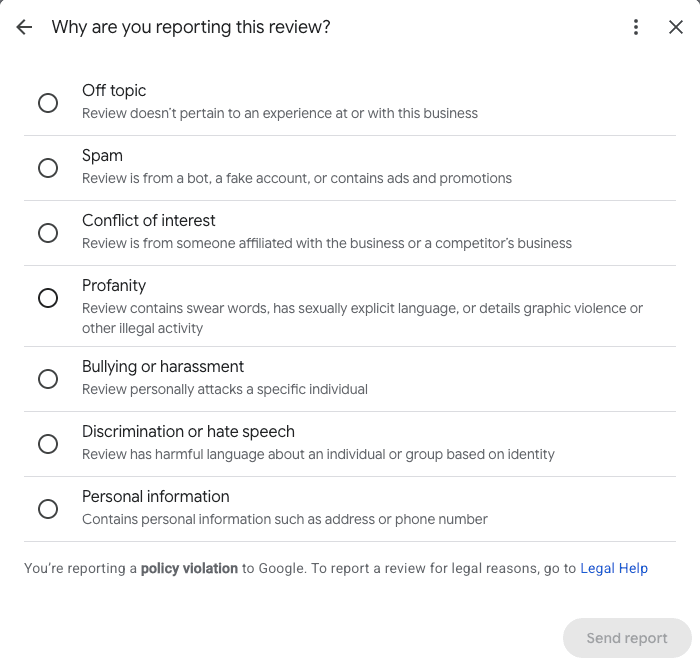
"Decision pending.".
The review is flagged, but Google hasn't checked it yet. Google says a check typically takes several days.
"Report reviewed - no policy violation.".
Google checked the review and found no policy break. The review stays up.
Send the one-time appeal.
If a flagged review doesn't qualify for removal, Google lets you send a one-time appeal. You can select up to 10 reviews in it.
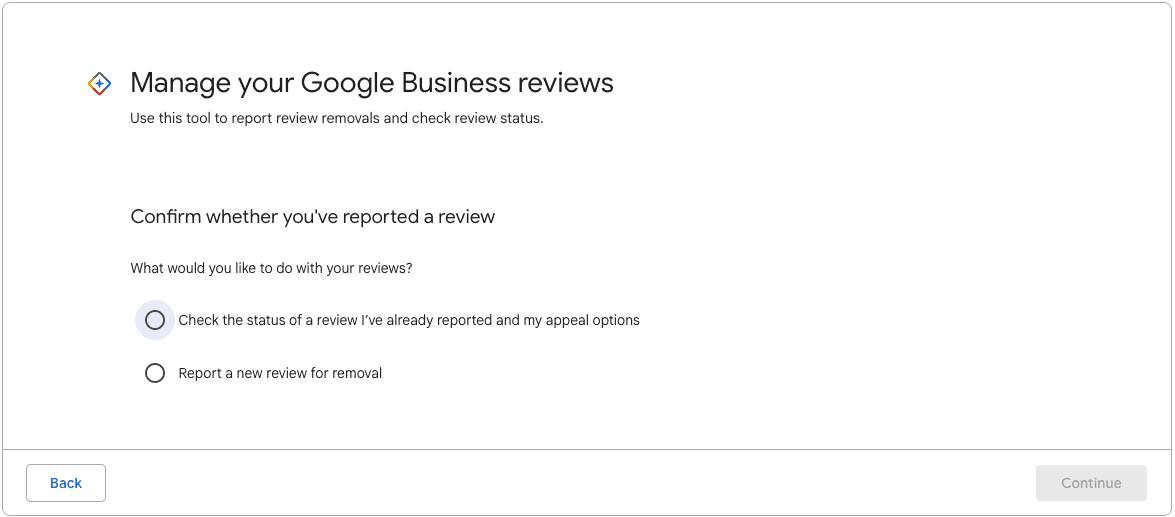
Watch your email.
Google's page also lists the status "Escalated - check your email for updates." After an appeal, a review that follows Google's policies will stay live. A review that breaks them comes off Maps and Search.
When a wave of fake reviews hits
A sudden pile of fake reviews is a pattern, and Google's policy names it. Google's Maps content policy lists unusual volumes or patterns of reviews.
On April 16, 2026, Google announced new protection for a sudden spike of fake reviews. It said it would remove the fake content and pause new reviews. It also said it would alert the owner and show a banner. The post said this was coming in the weeks ahead (Google's April 2026 post).
Google's page for shoppers says they may see a banner on a business's page. It tells them suspicious reviews were removed (Google's page on consumer alerts). Google can also show shoppers a warning on a profile that itself broke Google's rules. The next part covers that.
Someone may demand money to stop the reviews or take them down. That's review extortion, and Google has a separate form for it. Google says not to deal with or pay the people behind it. The form is only for a direct extortion attempt. Plain spam or off-topic reviews go through the normal report (Google's page on review extortion scams).
Don't answer fake reviews with fake ones
Some moves make things worse, and they can put your own profile at risk.
- Don't have staff or family post reviews to bury it. Google's policy names family and current or former employment as a conflict of interest. Reviews should come from a real experience (Google's Maps content policy).
- Don't pay or reward anyone for a review. Google says incentives are fake and misleading content, and they're strictly prohibited (Google's tips to get more reviews).
- Don't risk the reviews you already have. If a profile breaks Google's policies, Google can unpublish its existing reviews for a set period, or warn shoppers that fake reviews were removed (Google's page on Business Profile restrictions).
Reply once, then let real reviews outweigh it
While a review stays up, two things are in your hands: your reply and your next reviews.
Google says the person who wrote the review is notified when you reply. A customer can still change their review after reading your reply (Google's page on managing reviews). We'd reply once, short and calm, because the reviewer is notified the first time. If you have no record of the job, say so.
Your review score is the average of all ratings published on Google. A new review can take up to 2 weeks to show in it (Google's page on review scores). So each new real review makes one fake rating count for less. Google also says more reviews and positive ratings can help your local ranking (Google's local ranking tips).
Shoppers look at that average. BrightLocal asked a panel of 1,002 US adults through SurveyMonkey for its 2026 survey. In it, 68% said they only use a business with 4 stars or more. That's BrightLocal's finding, published February 11, 2026 (BrightLocal's Local Consumer Review Survey 2026, read November 17, 2026).
See how many 5-star reviews it takes to reach your goal. Our guide on whether a business can delete Google reviews covers what an owner can do instead.
Here's what we do today. When a job is marked done in your CRM, we text the customer a photo. It shows someone on your team holding a whiteboard with the customer's name. The photo gets their attention. Then the text asks for the review, with your review link. We ask every customer the same way. See how it works.
Once your CRM is connected, the texts start. On average, the first new Google reviews come in about 48 hours after that. $150 a month covers up to 100 review requests. See pricing.
I built ReviewsOS for my own insulation company first. These are our own numbers, not figures from an outside study.
About 30% of new customers typically post a review
Over 50% at some companies
35 Google reviews in 14 days: my first run, to past customers of my own insulation company
Questions owners ask when Google says no
How long does Google take to remove a fake review?
Google says a check typically takes several days (Google's page on reporting reviews). Its page gives no time for an appeal. While you wait, we'd reply to the review and keep asking every customer for a review.
How do I contact Google about a fake review?
The routes on Google's pages are the report from your Business Profile and the one-time appeal (Google's page on reporting reviews). You follow a report's status in Google's Reviews Management Tool. For review extortion, Google has a separate form. It's only for someone who demands money from you (Google's page on review extortion scams). A company may offer to take reviews down for a fee. The Google pages in our sources name no paid route to removal. Google removes a review when it breaks a policy. If yours doesn't, we'd reply once, then let new real reviews outweigh it.
Can a business get in trouble for fake reviews on Google?
On Google, yes. A profile that breaks Google's policies can be blocked from new reviews for a set period. Businesses can appeal that decision (Google's page on Business Profile restrictions). Google's tips page says a reward for a review is fake and misleading content, and strictly prohibited. The same page gives the allowed route: "To leave reviews, you can ask customers to visit a Google link or scan a QR code" (Google's tips to get more reviews). We ask every customer the same way. See how it works.
Will a fake review come back after Google removes it?
No. Google says reviews removed for policy violations won't be restored (Google's page on missing or delayed reviews).
Sources
- Report inappropriate reviews on your Business Profile, Google Business Profile Help, read November 17, 2026
- Fake engagement (Maps User Generated Content Policy), Google, read November 17, 2026
- Prohibited & restricted content (Maps User Generated Content Policy), Google, read November 17, 2026
- How reviews on Google Maps work, Google Keyword blog, February 2, 2022, read November 17, 2026
- New ways we're protecting businesses on Maps, Google Keyword blog, April 16, 2026, read November 17, 2026
- Manage your Google Business reviews, Google Business Profile Help, read November 17, 2026
- Consumer alerts (Maps User Generated Content Policy), Google, read November 17, 2026
- Report negative review extortion scams on your Business Profile, Google Business Profile Help, read November 17, 2026
- Tips to get more reviews, Google Business Profile Help, read November 17, 2026
- Business Profile restrictions for policy violations, Google Business Profile Help, read November 17, 2026
- Manage customer reviews, Google Business Profile Help, read November 17, 2026
- Understand review scores for local places & businesses, Google Business Profile Help, read November 17, 2026
- Tips to improve your local ranking on Google, Google Business Profile Help, read November 17, 2026
- About missing or delayed reviews, Google Business Profile Help, read November 17, 2026
- Local Consumer Review Survey 2026, BrightLocal, February 11, 2026 (a representative panel of 1,002 US adults, via SurveyMonkey), read November 17, 2026
We’ll get you 10 Google reviews for free to prove it works.
We start with the customers you've already served.
No card needed, First reviews in 48hr, 15-min setup call
Or see it first: get the text your customers will get.